
Honda Fit: Valve Body and ATF Strainer Removal (A/T)
-
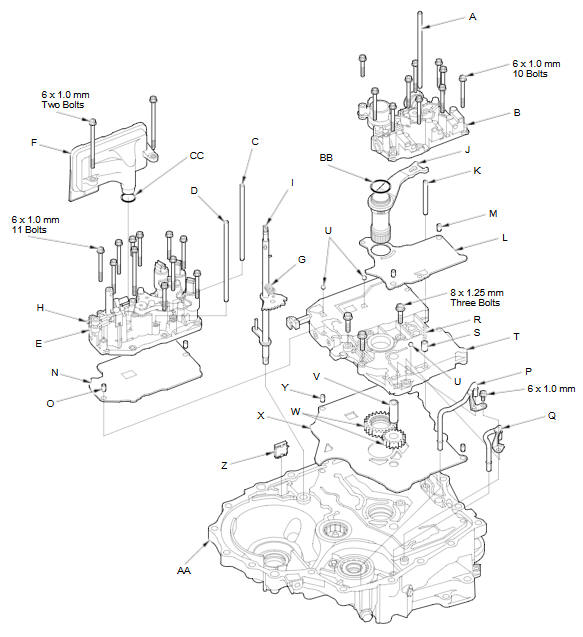
Remove the ATF feed pipe (A) from the regulator valve body (B).
-
Remove the ATF feed pipes (C) (D) from the servo body (E).
-
Remove the ATF strainer (F) (two bolts).
-
Unhook the detent spring (G) from the detent arm (H), and remove the control shaft (I).
-
Remove the regulator valve body (10 bolts).
-
Remove the stator shaft (J) and stator shaft stop (K), then remove the regulator separator plate (L) and two dowel pins (M).
-
Remove the servo body (11 bolts), then remove the separator plate (N) and two dowel pins (O).
-
Remove the ATF joint pipes (P) (Q).
-
Remove the cooler check valve spring (R) and cooler check valve (S), then remove the main valve body (T) (three bolts). Do not let the check balls (U) fall out.
-
Remove the ATF pump driven gear shaft (V), then remove the ATF pump gears (W).
-
Remove the main separator plate (X) and two dowel pins (Y).
-
Remove the ATF magnet (Z), clean and reinstall it in the torque converter housing (AA).
-
Remove the O-ring (BB) from the stator shaft, and remove the O-ring (CC) from the ATF strainer. Install new ones when installing the valve bodies.
-
Clean the inlet opening (A) of the ATF strainer (B) thoroughly with compressed air, then check that it is in good condition and that the inlet opening is not clogged.
-
Test the ATF strainer by pouring clean ATF through the inlet opening, and replace it if it is clogged or damaged.
See also:
Audio Commands
The system accepts these commands on
most screens.
Audio*
Audio on
Audio off
* These commands toggle the function on and off, so the command may not match
your intended action.
NOTE:
Audio vo ...
Checking Tires
To safely operate your vehicle, your tires must be of the proper type and
size, in
good condition with adequate tread, and properly inflated.
■ Inflation guidelines
Properly inflated tire ...
Mainshaft Disassembly, Inspection, and Reassembly (A/T)
Inspect the thrust needle bearings and the needle bearings for galling
and rough movement.
Inspect the splines for excessive wear and damage.
Check the shaft bearing s ...
Categories
