
Honda Fit: Protecting Your Discs
General Information
• When using CD-R or CD-RW discs, use only high quality discs labeled for audio use.
• When recording a CD-R or CD-RW, the recording must be closed for it to be used by the system.
• When recording a CD-R or CD-RW, the recording must be closed for it to be used by the system.
• Handle your discs properly to prevent damage and skipping.

Do not use discs with adhesive labels.
The label can curl up and cause the disc to jam in the unit.
Protecting Discs
When a disc is not being played, store it in its case to protect it from dust and other contamination. To prevent warpage, keep discs out of direct sunlight and extreme heat.
To clean a disc, use a clean soft cloth.
Wipe across the disc from the center to the outside edge.
A new disc may be rough on the inner and outer edges. The small plastic pieces causing this roughness can flake off and fall on the recording surface of the disc, causing skipping or other problems.
Remove these pieces by rubbing the inner and outer edges with the side of a pencil or pen.
Never try to insert foreign objects in the disc player.
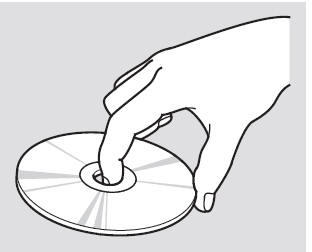
Handle a disc by its edges; never touch either surface. Do not place stabilizer rings or labels on the disc.
These, along with contamination from finger prints, liquids, and felttip pens, can cause the disc to not play properly, or possibly jam in the drive.
Additional Information of Recommended Discs
The in-dash disc player has a sophisticated and delicate mechanism. If you insert a damaged disc as indicated in this section, it may become stuck inside and damage the audio unit.
Examples of these discs are shown to the right:
1. Bubbled, wrinkled, labelled, and excessively thick discs
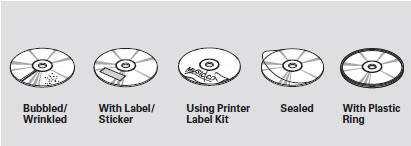
2. Damaged discs
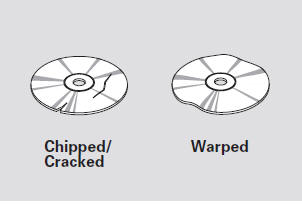
3. Poor quality discs
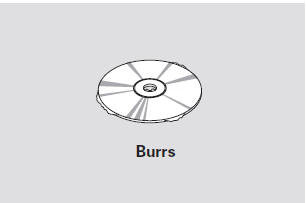
4. Small, irregular shaped discs
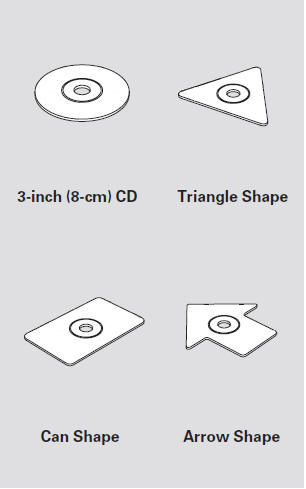
5. Discs with scratches, dirty discs
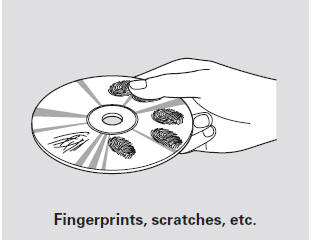
• CD-R or CD-RW may not play due to the recording conditions.
• Scratches and fingerprints on the discs may cause the sound to skip.
• Recommended discs are printed with the following logo.

• Audio unit may not play the following formats.

See also:
Front Passenger's Airbag Replacement (Installation)
Installation
Insert the hooks (A) of the front passenger's airbag housing into the new
front passenger's lid, then insert the other hooks (B) into the panel.
NOTE:
Make s ...
A/T System Description - Hydraulic Controls (A/T)
Hydraulic ControlsThe valve body includes the main valve body,
the regulator valve body, and the servo body. The ATF pump is driven by
splines on the end of the torque converter which is atta ...
Recommended CDs
• Use only high-quality CD-R or CD-RW discs labeled for audio use.
• Use only CD-R or CD-RW discs on which the recordings are closed.
• Play only standard round-shaped CDs.
A Dual-disc cann ...
Categories
